Choosing the Perfect Sympathy Flowers
The hardest flowers to order are the ones you send when you don't know what to say.
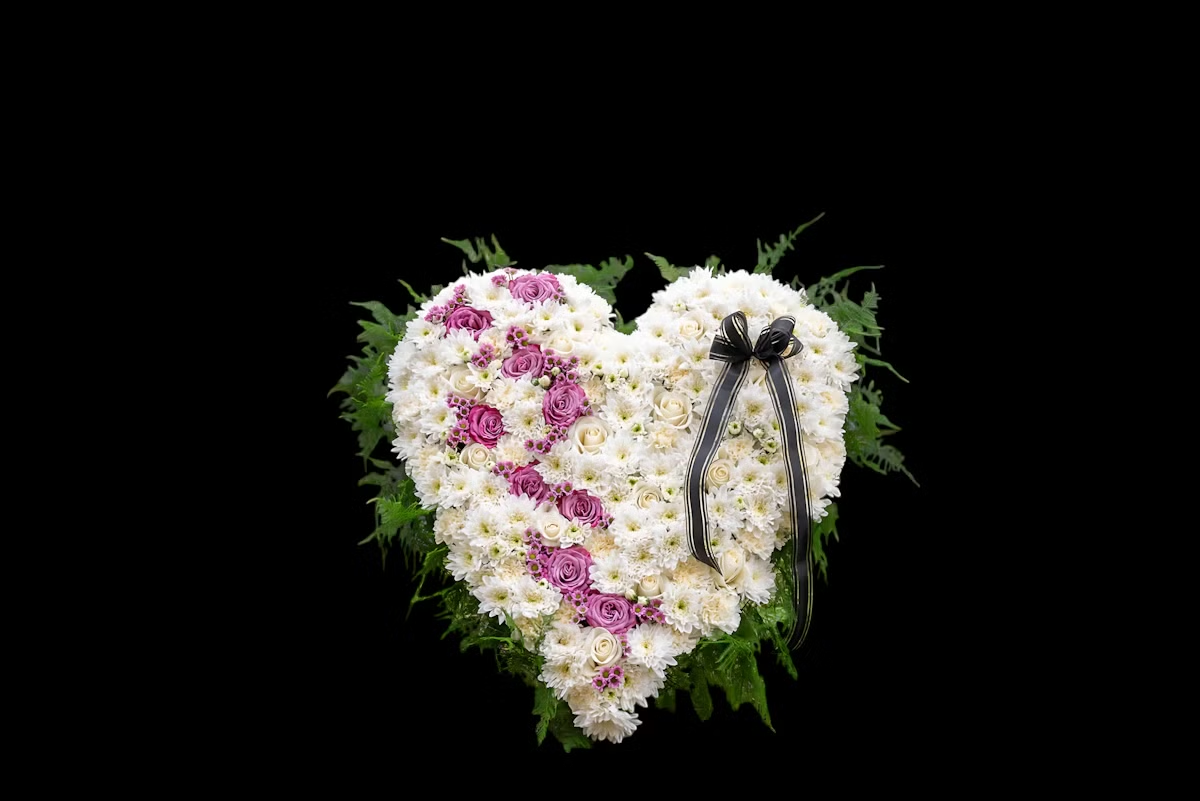
The hardest flowers to order are the ones you send when you don't know what to say. A death arrives and language fails — the text you draft three times and delete, the voicemail you can't quite leave — and flowers step into that silence with something more honest than words. They don't fix anything. They aren't supposed to. What a well-chosen sympathy arrangement does is take up space in a room that suddenly feels too quiet, and tell someone that on the worst week of their life, they were held in someone's mind.
After years of sending stems to Gawler's on Wisconsin Avenue, to services at the Washington National Cathedral, to shiva homes in Cleveland Park and reception tables in Capitol Hill rowhouses, we've learned that choosing well is less about knowing the "rules" of funeral flowers and more about knowing where the flowers are going, who will see them, and what that person needs at that particular hour of grief.
The First Question Is Never the Flower — It's the Destination
A standing spray sent to a private home is an awkward guest. A small hand-tied bouquet sent to a large funeral service disappears against the scale of the room. Before we ever discuss color or bloom, we ask where the flowers will land, because that single detail determines everything about form, scale, and mechanics.
There are essentially three destinations, and each asks for something structurally different:
- The service or funeral home. Vertical, visible, designed to be read from twenty feet away. A Sympathy Standing Spray is built for exactly this — an easel-mounted piece of white oriental lilies, cream roses, and snapdragons that holds its own beside a casket or urn at St. Matthew's, at Joseph Gawler's Sons, at a chapel in Rock Creek Cemetery. These are sent to arrive an hour before the service, never during it.
- The family home. Low, self-contained, no vase to find, no water to fuss with. A grieving family should not have to hunt for a container in a cabinet they can't bear to open. Our Garden Sympathy Basket arrives fully hydrated in its own vessel — white ranunculus, soft hydrangea, seeded eucalyptus — and asks nothing of anyone.
- The office or workplace. Often overlooked and often the kindest gesture of all. Someone returning to a desk on the Hill or in a Farragut Square office after burying a parent will find that a quiet arrangement on the credenza does more emotional work than any all-staff email.
The timing question matters as much as the address. Flowers sent the week of the service arrive into a house already crowded with casseroles and cousins. Flowers sent three weeks later — when the phone has stopped ringing and the folding chairs have been returned — arrive into the emptiest, loneliest stretch of grief. If you can only send once, consider sending late.
Grief has a long tail. The condolence that arrives in week four, when everyone else has moved on, is the one people remember for the rest of their lives.
What the Flowers Actually Say
The Victorian language of flowers is mostly a parlor game now, but a few meanings have survived because they were true enough to last. White lilies — particularly the oriental varieties with their heavy, ceremonial perfume — have signaled the restored innocence of the departed soul for centuries, which is why they anchor nearly every traditional Western funeral design. Chrysanthemums carry death associations across much of Europe and Asia and are the definitive funeral flower in Japan, Korea, and France. Roses, in white, speak to reverence; in deep red, to grief that is also love.
But here is what we tell people who agonize over symbolism: the recipient will not decode your arrangement. They will feel it. The far more meaningful choice is a personal one — the flower that belonged to the person who died. Someone's mother grew peonies on a Takoma Park porch. Someone's grandfather kept a rose garden in Anacostia. Someone's partner brought home ranunculus every Friday from the Dupont Circle farmers market for eleven years running. That specificity lands like a hand on a shoulder.
This is also why we frequently steer people away from stark all-white designs toward something gentler and more garden-like when the flowers are going to a home. A piece like the Logan Circle Blush Garden — blush garden roses, lisianthus, soft antique tones — reads as tenderness rather than ceremony. It is the arrangement for the mother who lost an adult child, the widow in her first month, the friend who does not need to be reminded that a funeral happened. She knows.
Faith, Culture, and Getting It Right
Washington is one of the most religiously varied cities in the country, and sympathy flowers are one of the places where a well-meant gesture can miss. A few practical realities we navigate constantly:
- Jewish services. Flowers are traditionally not brought to the funeral or the graveside. Food sent to the shiva home is customary. Some more liberal Reform families welcome flowers at the shiva house, but the safe and respectful default is to send a plant or arrangement to the home after the shiva period concludes, or to make a donation in the deceased's memory.
- Islamic services. Funerals are simple by design and typically held within twenty-four hours. Flowers are not customary at the janazah, though many families in the DMV welcome an arrangement sent to the home during the mourning period afterward.
- Catholic services. Flowers are welcome and traditional, though many parishes ask that arrangements be delivered to the funeral home rather than the church itself. Standing sprays and casket pieces are coordinated with the funeral director — always call.
- Hindu services. White and yellow flowers, particularly marigolds and jasmine, are traditional. Garlands rather than Western-style arrangements are often the appropriate form.
One more consideration that comes up more than people expect: pets. A household in mourning is a household where nobody is watching the cat. Lilies are acutely toxic to cats — even pollen tracked onto fur and groomed off can cause kidney failure — and the last thing a grieving family needs is a veterinary emergency. When we know there are animals in the home, we send something like the Pet-Friendly Blush Garden, built entirely from blooms that are safe around cats and dogs. It is a quiet kindness the family will never have to think about, which is precisely the point.
Writing the Card, and What Comes After
People spend forty minutes choosing flowers and forty seconds on the card, which is backwards. The flowers will fade. The card gets tucked into a drawer and found again in five years. Say the person's name. Say a specific thing you remember about them — the way they laughed too loud at their own jokes, the fact that they never once let you pay for lunch. Avoid "everything happens for a reason." Avoid "let me know if you need anything," which puts the labor of asking on the person least able to do it. Say instead: "I'm bringing dinner Thursday. I'll leave it on the porch."
Then keep going. The most powerful use of flowers in grief is not the single funeral arrangement but the repeated gesture — something small on the anniversary of the death, on the birthday, on the first Christmas. A modest Georgetown Blush & Ivory arriving on a Tuesday in March with a note that says only "thinking of him today" is worth more than the largest spray at the service. We keep dates for clients and send quietly, year after year, to homes from Kalorama to Navy Yard.
Practically: sympathy flowers should be received, not left. Our couriers hand-deliver across the District and inner suburbs, and for home deliveries we ask for a phone number so we can confirm someone is there. For services, we coordinate directly with the funeral home on placement and timing. And when the arrangement arrives, the care guide handles the rest — because nobody in a house of grief should be troubleshooting cloudy vase water.
Tell us where the flowers are going and what the person was like — we'll design the rest and time the delivery around the service. Browse occasions or start with our sympathy arrangements and bouquets.
Tempo Lazer
Tempo Lazer Flowers Studio
More in Occasions

Retirement Flowers That Honor the Work
Retirement flowers should recognise a body of work without implying that the recipient is old, relieved to escape or obligated to perform gratitude for a workplace.

Flowers for a Naturalization Ceremony
A naturalization ceremony marks citizenship after a process that may have taken years.

Flowers for an Adoption Celebration
Flowers for an adoption celebration should welcome a family without turning a complex, private process into a sentimental script.